John Candy – A Life in Comedy by Paul Myers
“There is a word in our language we don’t hear much anymore, but it applies to Candy, the word is grand,” John Candy’s close friend and colleague Dan Aykroyd said while eulogizing the late comedian and actor in 1994. “He was a grand man.”1
John Candy was indeed a big man, six foot, three inches tall, who often struggled to control his weight, and the word “grand” could be used to describe his physical presence. But Aykroyd was speaking more in terms of Candy’s huge personality, his wonderful way of treating those around him with respect and honor, the love he shared for his family and friends, and the extensive catalog of television, radio, stage, and movie work he left behind.
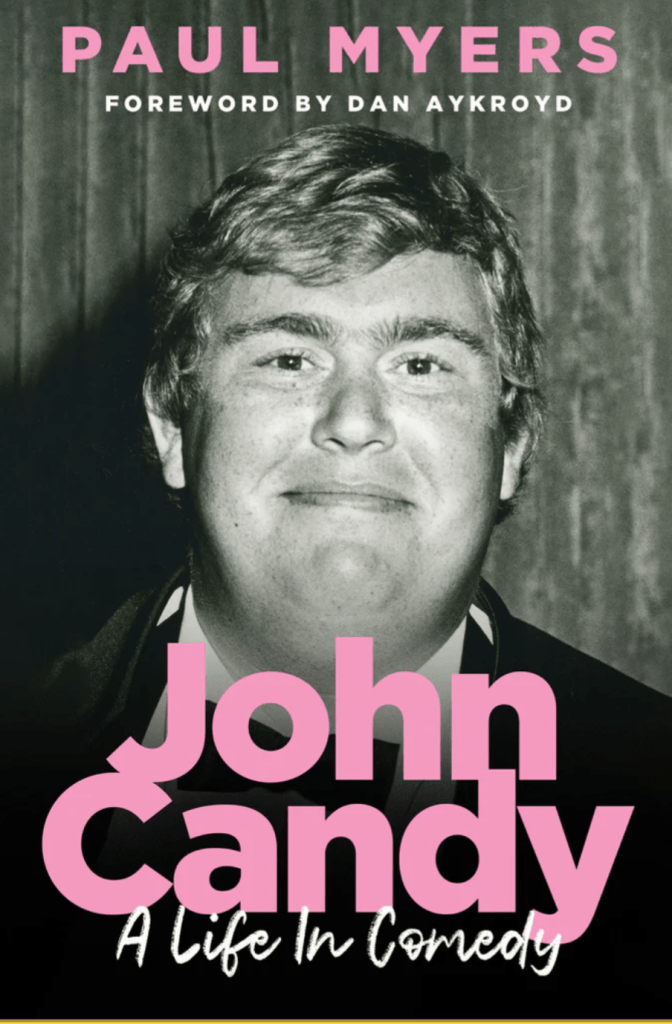
Candy was indeed a grand man, and biographer Paul Myers does a great job of allowing readers to better understand his life and accomplishments. Myers interviewed Candy’s family, friends, SCTV colleagues, other actors, and more for the book, and the depth of his research definitely comes through.
Catherine O’Hara, Candy’s long-time friend and colleague on SCTV who also appeared with him in the movie, Home Alone, described John as an honorable and dependable man. “John had principles,” she said; “he lived by them, he worked by them. He set a good example in so many ways. He was a protector. He cared. If he felt you’d been wronged in any way, he’d risk everything to make it right. To make you know you were worth something, too. In a business that indulges the weaker souls, where the insecure lend others’ words far too much meaning, John was a humble, sensitive man, full of faith, who seemed forever grateful for his gifts, and his time on this earth.”2
Ironically, as I wrote this book review, the news of Catherine O’Hara’s death at age 71 appeared on my computer screen. She, too, was a talented and accomplished performer, and the way I imagine it, she and Candy can now once again have tremendous fun doing improv scenes together in heaven.
Myers shares the story of Candy’s childhood, which was marred by the death of his 35-year-old father a few days before John’s fifth birthday. This trauma affected John throughout his life, both during his formative years and then as an adult. Candy believed he, too, would not live to be an old man, and his inner turmoil presented itself through anxiety, crippling panic attacks, and self-destructive behavior that contributed to his death at age 43.
Watching his performances, from the physical slapstick improv routines to the comedic and then dramatic movie roles, you would not believe Candy was often brought to his knees by panic and an overwhelming sense of loss. But he was, and that drove him to work continually to provide for his family and make his mark on the world while he could.
The funny man, playing the half-man/half-dog role in Spaceballs, the young and overweight Army recruit in Stripes, or the amazingly agile water skier in The Great Outdoors, was himself wounded inside since childhood. He brought that depth of character to the screen as the incredibly funny yet lonely shower curtain ring salesman, Del Griffith, in Planes, Trains & Automobiles, and as Officer Daniel “Danny” Muldoon in Only The Lonely.
His cameo appearance alongside Catherine O’Hara as polka musician Gus Polinski in Home Alone showed both sides of his brilliance – the tender and caring man who offers a distraught mother a ride home to Chicago in a rental truck with his fellow musicians, as well as the polka band leader who plays the clarinet to entertain and distract her from her troubles along the way.
John Candy was a multi-faceted man as well as a versatile actor, writer, and director. He took his responsibilities as a husband, father, son, friend, and colleague seriously, stood up for all he believed in, helped others in need, and did all he could to honor his Canadian roots.
He knew he needed to take better care of himself, but often reverted back to overindulging in food and drink. He wanted to be around to raise his children and be there for his wife and family. He wanted to write, make additional movies, and help his colleagues continue working. He wanted to be funny, and he wanted to be taken seriously. He was an everyman who treated everyone with respect. Candy wanted to be successful and he wanted to matter.
Paul Myers does a good job telling John’s life story and his many contributions. Read John Candy – A Life in Comedy and you will agree he not only mattered, he made people love and appreciate him. He was real. He was honest. And he was caring.
The only regret is what might have been had he lived to old age. We are left wondering about the laughter and light we missed since John Candy left our world, and we can learn much from the good works he did and the inner challenges he faced during his time here with us.
“I like me,” Del Griffiths says during a significant scene in Planes, Trains & Automobiles, and that sums up how most people feel about John Candy. We like him, too. He continues to make our days happier and complete, and this book telling the story of his life makes us like and miss him even more. – DAJ
###
Class Clown…The Memoirs of a Professional Wiseass
How I Went 77 Years Without Growing Up by Dave Barry
Despite the fact it is, indeed, often difficult to write humor, Dave Barry enjoyed a long career as a humor columnist in The Miami Herald and was syndicated in hundreds of additional newspapers. He retired from that longstanding gig back in January 2005, but continues to write books and occasional articles.
I, for one, am glad he keeps a hand in the writing life while also enjoying “semi-retirement.”
Barry said he wanted to end his column before he began repeating himself, writing it without the energy and enthusiasm he’d had previously, or his readers started thinking he was no longer funny. “I worked hard to make sure each column was genuinely new,” he writes, “But I could see a time coming when I’d get tired of that effort, and I didn’t want to get to the point where I was phoning it in.”3
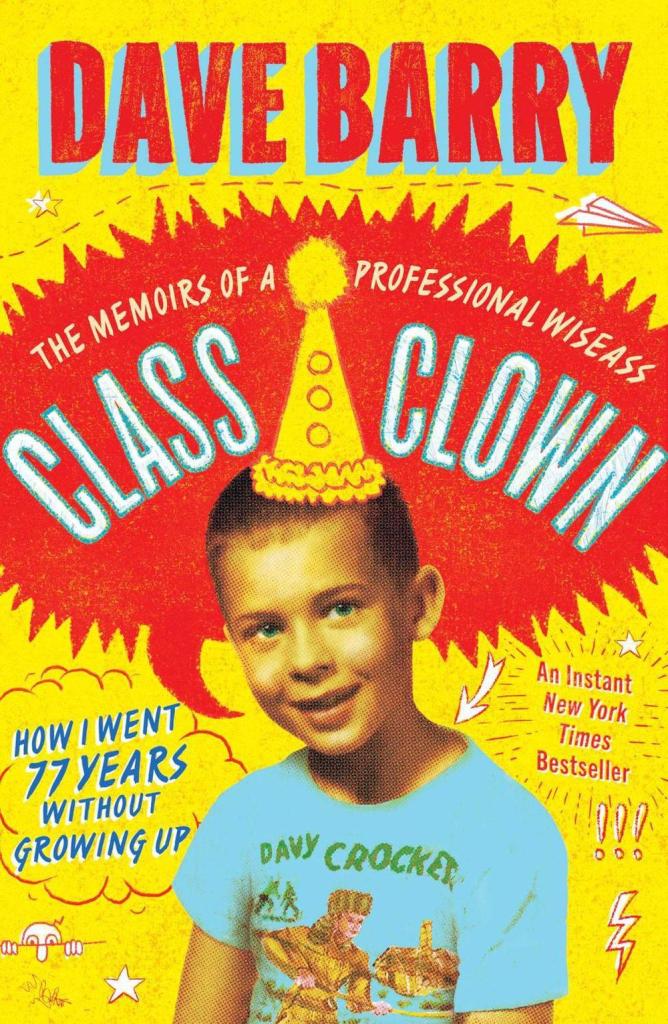
While readers no longer have his regular column readily available for a few laughs, his most recent book, Class Clown…The Memoirs of a Professional Wiseass – How I Went 77 Years Without Growing Up provides both levity and a look into the more serious aspects of his life.
He does reach back to his column for some of the funny parts of the book, but that’s okay as it feels nostalgic for the most part. Near the end of the memoir, though, for example when he includes a long list of potential names for the band he and some fellow writers have had for years, the read can become tiresome.
Fortunately, he rescues it with some profound thoughts on life, writing, aging, fear, and loss. You wouldn’t necessarily expect that from Dave Barry, but it is there in good measure. He is also good at sharing painful events, such as his father’s battle with alcoholism and subsequent death, and then quickly lightening the mood with humor.
At the end of the story about his father’s funeral, with everyone crying and feeling sad, Barry makes a fast transition to levity when he tells of his mother noticing a friend’s name on a nearby tombstone. She casually observes this must be why nobody sees this friend anymore, and the reader can only smile and keep reading.
His mother later took her own life and Dave and his siblings were left wondering if they could have done anything to stop her. “But the dominant emotion I feel when I remember my mom isn’t guilt, it’s gratitude,” he writes. “She was the sharpest and funniest person I knew; I owe much of my personality, and all of my career, to her. I wouldn’t reduce her life to a struggle with depression any more than I’d reduce my dad’s life to a struggle with alcoholism. They were both good people – smart, funny, decent people – and although they definitely weren’t Ozzie and Harriet, they were excellent parents and role models. They gave us Barry kids a wonderful childhood, and they taught us, by the way they treated others, how they believed a person should act.”4
That’s powerful. Thanks to Barry’s candid telling of both the good and bad things from his life, we are left with a clear picture of Dave Barry not only as a funny guy, but also a good and wise one.
There is much in this memoir to make readers laugh, and much to make readers think about the more important things in life – like not wasting the time we are blessed to have, telling those you love how you feel about them, not confusing your career with your life and overall identity, and the importance of humor and laughter each day.
The book is filled with Dave Barry’s interactions with famous people, from those in the entertainment world to government and other well-known writers. His story about being asked by Steve Martin to join the team of writers helping Martin prepare to host the Oscars is interesting, funny, and inspiring.
Barry is able to toss out interesting observations casually and he ends his book with some profound thoughts more often identified as coming from a philosopher than a humorist. But I agree with him that humor makes just about anything better.
For a guy who tells us he gets his writing ideas from Costco, he does a great job of making them stand out. You’ll likely read Class Clown for the laughs yet come away from the experience amazed at the wisdom within its pages and with a more positive outlook on life.
Thanks, Dave. – DAJ
###
Twice by Mitch Albom
The dust jacket on Mitch Albom’s new book, Twice, asks the following question: “What if you got to do everything in your life again?” It is an intriguing question to say the least and immediately draws the reader into the novel.
According to the author’s website, “The heart of Mitch Albom’s newest novel is a stunning love story that dares to explore how our unchecked desires might mean losing what we’ve had all along”5
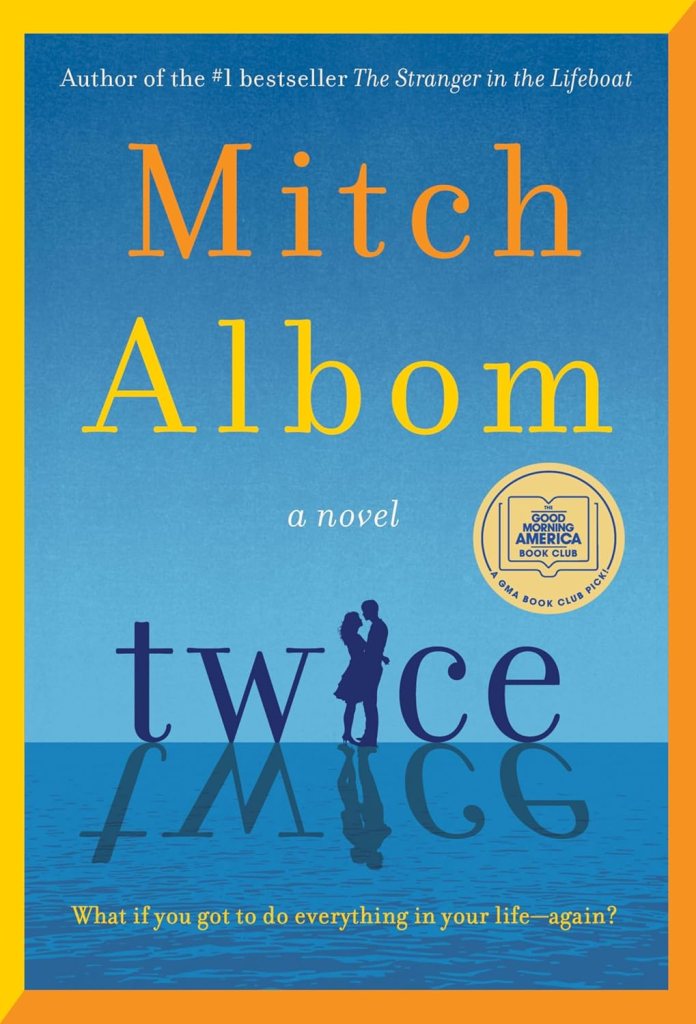
As is typical in many books by Albom, the reader is asked to suspend belief, take a spiritual journey, and enter a world where anything is possible. Twice, centers on the story of Alfie Logan, who has the ability to say the word “twice” in order to go back in time, re-live/re-do things, and change their outcomes.
Sounds great. Who wouldn’t want to be able to rewind the tape to correct mistakes and missteps? But Alfie’s unique ability, which he got from his mother, does not provide total success, as Alfie must accept the outcomes of his do-overs and there is no guarantee the second time will be better. He is also limited in his ability to affect certain emotions like love, and when he tries to alter events to save a friend’s life, he discovers his ability fails to prevent death.
While not giving too much away, the story focuses on a casino security interrogation after Alfie wins a considerable amount of money at extremely unlikely odds and is accused of cheating. He steadfastly maintains his innocence, although the reader cannot help but think Alfie used his ability to do things over again to ensure he would win.
Alfie tells the investigator the explanation can be found in the journal he has been keeping, and the story progresses as the investigator reads it. We learn about Alfie’s longtime love for Gianna, and the journal tells of his many do-overs throughout the years, as well as his dedication and devotion to her.
His life story – and the casino investigation – come to an unlikely conclusion with a surprising plot twist; even though we know Albom’s books typically are about love, kindness, and the incredible power of the human spirit. This book is a bit different in plot, though, even for Albom, and it is thanks to his writing and storytelling talent that he is able to successfully bring everything together at the end of the novel.
Here are a few lines from the book I found to be particularly interesting and thought provoking:
- “Secrecy is a liar against your better judgment. You pay the interest in regret.” (Page 209)
- “Some events in life you process as they happen. Others take a lifetime to understand.” (Page 216)
- “Another truth about true love: it makes you feel like you belong someplace.” (Page 235)
- “Sadly, when you lose yourself, you don’t realize who else you’re losing, too.” (Page 241)
- “We invent all kinds of theories about how our hearts get broken, when we’re the ones who drop them on the floor.” (Page 263)
That should pique your interest and desire to read Twice. While I have appreciated Albom’s books to varying degrees, I have yet to be disappointed by any of them, and Twice delivers as promised.
Entertaining, thought provoking, and suspenseful, Mitch Albom’s new book is one you just might want to read…twice.
###
Mark Twain by Ron Chernow
Books written by noted biographer Ron Chernow are typically not for the casual or occasional reader, but more for those who love history and search for considerable detail about historical figures. Chernow accomplished this with his previous tomes about George Washington, Ulysses S. Grant and Alexander Hamilton, and he has done so once again with his latest biography of Mark Twain.
And this latest effort may be his most complex, since Chernow wrote about two men in one – the person, Samuel S. Clemens, and the writer and orator, Mark Twain.

Including notes, the book is 1,200 pages, so it is obvious that Chernow takes a detailed deep dive into the life, successes, and failures of the famous American author of Tom Sawyer, The Adventures of Huckleberry Finn, A Connecticut Yankee, and so much more.
This level of detail reads well as Chernow tells of Twain’s early life in Missouri on the Mississippi River and his travels and adventures in the old west – likely because Twain writes of his childhood home and informative years in his novels. The book slows down, though, while sharing about Twain’s later years and his numerous personal and business setbacks.
Chernow paints a picture of the outgoing and gregarious Twain who, despite being recognized as America’s greatest humorist, longs to be taken seriously. Samuel Clemens was a man who felt strongly about the things happening around him and was quick to share his opinions in public as a newspaper journalist. So, Twain’s tendency to address controversial societal and political issues after he found fame was nothing new.
One of Twain’s flaws, though, was his highly impressionable tendency to immediately jump head first into an issue based upon the passion – right or wrong – of the person who last spoke to him about it. As a result, we see many instances of Twain strongly expressing his opinion only to do an about face later.
Despite some actions to the contrary, Twain was mainly consistent in his feelings about the plight of black people in America and spoke out often in support of expanded rights and improved opportunities. He also supported several black people financially, for example, paying educational expenses for them to go to school.
Chernow writes of Twain’s good and bad characteristics and actions, including the use of language in his books that, while vile and ignorant, was unfortunately common during his childhood years. While Twain spoke in favor of better education and treatment for blacks, for many years he held firm in his negative opinions related to native Americans. It was only much later in life that he softened that particular prejudice.
It is clear that Twain, while witty and funny, was also a powder keg who could explode into controversy at any time. Most often, he was against oppression, big government, and the system that he believed was designed to hold down the common man. At the same time, he led life enjoying the finer things that included employing butlers, drivers, and other house staff caring for his needs.
Accomplished as he was as an author, Twain was the opposite as a businessman and often acted on impulse regarding investments that resulted in financial distress. He was continually writing something new or out on a speaking tour because he had significant monthly expenses and considerable debt to repay.
I wrote a college essay long ago where I took the position that, among other desires, Twain primarily wrote Huckleberry Finn to make money. After all, writing was his occupation. My professor held an opposite opinion and my grade for that particular essay suffered. It was gratifying, then, to read Chernow’s book and see so much attention given to Twain’s seemingly never-ending quest for financial success.
Twain suffered many losses later in life, including the deaths of his wife, Livy, and daughters, Suzy and Jean, as well as people he trusted taking advantage of him. His only grandchild, a girl, was born after his death, which was sad because he longed for the days when he and Livy were raising their family, realizing he could have done a better job as an involved father.
Chernow gives considerable attention to the elder Twain’s fascination with youth and his efforts to recruit and spend time with his “angelfish” – young girls ages 10 to 16 years old. Chernow shares various opinions about this obsession, some unsettling to be sure, but despite Twain’s flirtations, emphasizes there were no actual sexual interactions.
Even the thought of that is abhorrent, but Twain was a lonely old man used to being in the spotlight and his angelfish looked up to him and made him feel he was still in the spotlight.
Twain was born during an appearance of Halley’s Comet and often said he would likely go out when the comet returned 75 years later. That is exactly what happened, and his time on earth was both lively and sad, successful and challenging, humorous and serious, and filled with volumes and volumes of experiences, books, articles, and letters.
That Twain is still relevant more than a century after his passing is reason enough to read about his life. Despite its length and some repetition, Mark Twain by Ron Chernow is worth your consideration.
###
On Character…Choices That Define A Life by General Stanley McChrystal, US Army Retired
The latest book by General Stanley McChrystal serves multiple purposes.
First, On Character…Choices That Define A Life moves forward what the General hopes will become a national conversation on character. Second, it enables him to share the foundation upon which he made numerous decisions throughout his long and impressive military and business career. And third, it hits the nail on the head regarding the character development sorely needed in today’s world.
While teaching at Yale University, General McChrystal often tasked students with writing their obituaries as they would like them to read many decades into the future. How would they like to be remembered? The assignment encouraged students to think about their character, the attributes that describe who they really are, who they would like to become, and how they live their lives. It’s a powerful and meaningful exercise.
The students thought about qualities such as respect, discipline, perseverance, honor, focus, dignity, dedication, learning from experience, and sound decision-making. These and more are included in On Character.
My favorite take-aways from the book include:
- “In my experience, I found that it was critical to both be, and appear to be, focused on the conversation – to ask questions even if you knew the answer. This signals you are engaged in the conversation and take the subject seriously. It also puts subordinates’ minds at ease.”6
- “Thinking, like physical conditioning, is a discipline that demands training and consistent practice.”7
- “Convictions set the direction of our intentions, but discipline provides the impetus to move. Without the discipline to adhere to them, our best beliefs are just opinions – and everybody has some.”8
- “The evidence of character lies in maintaining our most important convictions when it’s most tempting not to. None of us are perfect, but the more often we live out our convictions, the more we reflect personal discipline over ourselves.”9
- “Changing circumstances can warrant moving in a different direction, often on short notice. But the decision to quit should come thoughtfully, because breaking your commitments becomes a habit. Commitments easily abandoned often reset the value placed on all promises in our lives.”10
- “Sometimes, the only difference between success and failure lies in a person’s ability to persevere.”11
The book offers a pathway to living a life of service with high character; one where we can make the many inevitable decisions we face in such a way that we can look at ourselves in the mirror knowing we did our best.
While loaded with important virtues, the book’s most effective and memorable passages are found where General McChrystal offers insights into his personal life – often when he shares the strong traits and wisdom of his wife, Annie, and other family members.
For example, when faced with answering difficult questions (often for public consumption), the General advises, “Speak from your heart and to your granddaughters – that’s what I do. I know that what I say may be attacked in the near term, but I try to consider how Emmylou, Elsie, and Daisy will assess my comments in future years. That can seem foolish, but I think it is anything but. What I say and do must be aligned with the values I espouse and appreciated by the people whose judgment I care most about. Interestingly, that leads me to take the high road and the long view.”12
Life is filled with choices, and is best lived when the choices we make and the things we do reflect who we really are and the values we strive to uphold. A proud graduate of the West Point Military Academy, General McChrystal believes the West Point Cadet Prayer “captures the essence of behaving as we should, regardless of the costs: ‘Make us to choose the harder right instead of the easier wrong, and never to be content with a half truth when the whole can be won.’”13
Our society is sadly lacking in various components of strong character and integrity. On Character…Choices That Define A Life is not only recommended reading, it should be included in student classrooms from grade school through high school, as well as in college curriculums.
You will want to take notes when reading this important book and recommend it to others. I know I did.
###
The Idaho Four…An American Tragedy by James Patterson and Vicky Ward
James Patterson’s books always read so well that before you know it you have read the entire book. Even at well over 400 pages, The Idaho Four…An American Tragedy is no exception.
The first two sentences in the Authors’ Note at the beginning of the book set the stage for what the reader can expect: “This book reads like fiction, but none of it is made up. Every detail in these pages has been meticulously sourced through interviews or has been factually documented.”14

The story of four young college students being brutally murdered and the extensive work by law enforcement to identify and capture the killer is interesting and intense. At the same time, Patterson and his co-author, Vicky Ward, are able to humanize the victims so they are seen as young, innocent human beings rather than simply as crime statistics.
The book begins with the discovery of four bodies in a horrendous crime scene and the beginning of the meticulous police investigation into the murders. It then shifts to telling the story of the four students – Madison Mogen, Kaylee Goncalves, Xana Kernodle, and Ethan Chapin – who were brutally slain. Readers learn about the students themselves, their families and friends, and their dreams for the future.
That makes the book so effective, yet at the same time disturbing because the reader knows the students’ fates and is sickened by how they were killed. The book ends with Brian Kohberger in custody, but was published prior to Kohberger pleading guilty to the murders.
The many people who knew Kohberger over the years, while growing up, attending high school, going to college, and pursuing a doctorate in criminal justice, agreed he was different, strange, and often sullen. None, though, initially believed he could savagely and repeatedly stab four people to death. It wasn’t until after Kohberger’s arrest that the red flags in the back of everyone’s minds turned neon.
As you would expect with a grisly, multiple-victim murder in a relatively safe college town, people are afraid and demanding the killer be promptly caught. They want answers, but Moscow, Idaho, Chief of Police James Fry is caught between a rock and a hard place. He does not want to share all of the evidence the police have obtained, so as to keep the as of yet unidentified killer guessing about what investigators have discovered. It is gratifying to read later that the Chief and other investigators are vindicated when the investigation is completed.
The media presence in town is even greater than anticipated. The story leads the news both locally and nationally for an extended period of time, and it is not surprising when miscommunication and many wild theories result. Steve Goncalves, Kaylee’s Dad, is leading the charge for more transparency and repeatedly questions the capability, expertise, and professionalism of the investigators. That includes not only the local police department, but also the Idaho State Police and the FBI.
The reader wants Mr. Goncalves to remain quiet and let law enforcement do its work, but it is extremely difficult to fault him. He has tragically lost a daughter, as well as his daughter’s best friend, Maddie, who was at the Goncalves home so much that she is considered and treated as family. The families are shattered and each second without an arrest seems like an eternity.
(On a side note, my friend’s sister was murdered by her husband. The case took several years to resolve and I was always amazed by my friend’s restraint. He must have wanted to seek justice himself rather than face the drag of the investigation, the many delays along the way, and the slow wheels of justice. Remarkably, he refrained from taking matters into his own hands, and his brother-in-law was finally convicted and sent to prison. I couldn’t help but think of my friend while reading this book.)
The big question is why anyone would commit this terrible crime. Why would someone murder the four students, but leave two additional roommates unharmed? And why kill these particular people? Were they targeted or just extremely unlucky? The book takes you through the many facets of the investigation as clues are discovered, a DNA sample is processed, and a likely profile of the murderer is developed.
In time, Kohberger is identified as a suspect and the investigation follows him from the state of Washington across country to his parents’ home in the Pocono Mountain region of northeastern Pennsylvania. Investigators there observe Kohberger in the early morning hours before sunrise wearing nitrile gloves and putting the family’s garbage into a neighbor’s trash cans.
The trash provides a DNA sample of Kohberger’s father, and from that comparison investigators are more than 99 percent certain the DNA obtained at the Idaho crime scene is that of someone related to Mr. Kohberger.
As far as why the murders were committed, investigators look into the online comments of someone with the username of Pappa Rodger, who asks many detailed questions and makes several comments that match what the police know but have not yet made public. One of the online site administrators researches Pappa Rodger. “All that pops up in her search is the incel martyr Elliot Rodger, the twenty-two-year-old student in Santa Barbara who wrote a manifesto and in 2014 videotaped his plans to murder a bunch of people as revenge for all the women who wouldn’t sleep with him.”15
Incidentally, once Kohberger is arrested the strange online presence of Pappa Rodger goes silent.
The characteristics of an incel – someone who is involuntarily celibate – match well with what investigators are learning about Kohberger, and they look at this as a motive for the killings. In addition, Kohberger visited a vegan restaurant where Maddie Mogen worked, and police theorize she became his target for revenge on all of the women who turned Kohberger down over the years.
You have to read the book for the numerous details that result in Kohberger’s arrest and the preliminary court appearances leading to the decision that a trial, if held, would be moved to Boise, hundreds of miles away from Moscow.
The legal investigation and subsequent court tactics cause anger and frustration, but we now know Kohberger avoided the possibility of facing the death penalty by pleading guilty and will never be released from prison.
There is disgust for the evil killer, but also a feeling that Kohberger’s strange demeanor, life experiences, and past drug abuse somehow pushed him over the edge from what any normal person would never consider doing. (While there is a preference among many for Kohberger to face a firing squad, following publication of the book we learn they must come to terms with knowing he will never again see the light of day as a free man.)
The reader comes away from the book feeling sad and distressed about the senseless loss of life, questioning how much information law enforcement should share during an active investigation, pondering the proper punishment, and being filled with compassion for the families involved. Not just the Mogen, Goncalves, Kernodle, and Chapin families, but also Kohberger’s family who must live their lives knowing their son is a cold blooded and heartless killer.
May the four young, bright, and energetic college students who lost their lives in such a brutal manner – The Idaho Four – rest in peace. And may their families and friends continue to be comforted and strengthened by wonderful memories of the times before Brian Kohberger murdered their loved ones.
###
The Art of Communicating by Thich Nhat Hanh
Zen Master Thich Nhat Hanh, a well-known Buddhist monk and author of several books, offers a different perspective in The Art of Communicating that is essential for anyone wanting to connect and communicate effectively with themselves as well as with others.
The connection with ourselves is key because we must master that first before we can communicate effectively with other people. This is becoming more of a challenge as technology continues to invade our daily lives and texting, emailing, and posting on social media replaces simply talking as a primary means of communicating. People are spending more time alone with technology and this isolation hinders our communication abilities.
Not surprisingly, Nhat Hanh recommends breathing exercises and other mindfulness techniques to be in the proper frame of mind for effective communication to occur. Words have power, and communication is more successful when you use what he calls peaceful language. Such language, in fact, is part of Nhat Hanh’s Four Elements of Right Speech, along with tell the truth, don’t exaggerate, and be consistent.
He also shares his Six Mantras of Loving Speech: 1. “I am here for you.” 2. “I know you are there, and I am very happy.” 3. “I know you suffer, and that is why I am here for you.” 4. “I suffer, please help.” 5. “This is a happy moment.” And, 6. “You are partly right.” You can use the mantras to prepare for a wide variety of communication needs, and when you do, they get you in the proper frame of mind to communicate appropriately and effectively.
Nhat Hanh understands that many people are hurt because of difficult conversations and shares numerous ways to reconcile differences and communicate with compassion. When we are angry, for example, he advises us to do mindful breathing to recognize where our anger is coming from and calm it. Suppressing your anger will cause it to grow rather than decrease, and Nhat Hanh tells us to return to our mantras before talking with others.
The book covers communication scenarios at home as well as at work in the larger community. Importantly, Nhat Hanh shares how to conduct useful and worthwhile meetings and how to negotiate toward a solution acceptable to all those involved.
We must always remember that communication is more than words. Our body language, facial expressions, actions, and tone of voice all affect understanding, so it is imperative to be aware of and correct any ways we may be negatively affecting our communication.
Effective communication requires a sender sharing appropriate messages and making sure that the receiver understands the messages. It is a two-way process and stipulates active participation by all involved.
“Every time we communicate, we either produce more compassion, love, and harmony or we produce more suffering and violence,” Nhat Hanh writes. “Our communication is what we put into our world and what remains after we have left it.”
Our words and actions come from our thoughts, and Nhat Hanh is clear about the kind of thoughts we must have. “When you produce a thought of hate, anger, or despair, that thought is a poison which will affect your body and your mind,” he writes. “When you produce a thought that is full of understanding, forgiveness, and compassion, that thought will immediately have a healing effect on both your physical and mental health and on those around you.”
It’s our choice regarding how we want to communicate. Reading The Art of Communicating will help increase the probability that our communication will be helpful and productive – and that is certainly a worthy endeavor.
###
No More Tears – The Dark Secrets of Johnson & Johnson by Gardiner Harris
I spent much of the last 45 years working in public relations and marketing, with a major emphasis on and experience with issues, crises, and reputation management. The challenges, situations, and events I’ve handled over that time run the gamut from A to Z and from mild to severe. Given this background, I read No More Tears – The Dark Secrets of Johnson & Johnson by Gardiner Harris with great interest and attention.

It seems the entire book is one long crisis. In fact, it tells the unfathomable stories of a series of them.
The disastrous events, bad decisions, and misdeeds described in this book are enough to make any patient, or reputable communications and strategy professional for that matter, go running off into the night. While reading it, I often shook my head in disbelief at Harris’s description of J&J’s cavalier attitude toward patient safety and well-being. I knew I personally could not ethically represent such a company given the information as presented in No More Tears. My adherence to the Public Relations Society of America’s (PRSA) ethical standards and Code of Conduct wouldn’t allow it.
Then again, perhaps Johnson & Johnson was as good at convincing its own people (including its PR and other communications staff) that the company was always doing the right thing, as it was effective in delivering that message to those outside J&J.
Harris does a great job of investigative journalism in this book. He presents one example after another of Johnson & Johnson’s product failures, including the withholding of negative clinical trials data, company leaders’ sudden amnesia while testifying in court, various questionable monetary incentive marketing strategies, and applying ongoing and consistent pressure on regulators. As I read, I became more and more appalled and disgusted by J&J’s approach, actions, and overall arrogance as described.
Harris tells about a company that spends so much money on advertising and other marketing efforts it can pressure the media to report about it favorably for the most part; a company that can influence government oversight by investing huge amounts of money to fund the work of the U.S. Food & Drug Administration (FDA) – the very agency tasked with monitoring the efficacy and safety of Johnson & Johnson’s products; and a company able to mislead healthcare professionals with carefully worded marketing materials and stacks of money to keep doctors and researchers on their good side.
Johnson & Johnson had an extremely strong reputation on which to maintain trust and grow. The company brand consistently scored at the top by consumers who totally believed in its products such as Johnson’s Baby Powder and Johnson’s Baby Shampoo. It was this favorable position in the minds of consumers, regulators, media, and others that helped enable J&J to continue for many decades manufacturing and selling baby powder contaminated with asbestos and a myriad of other dangerous products.
J&J’s overall positive reputation helped it not only survive the Tylenol poisoning crisis in 1982, but also be lauded for its subsequent handling of the product tampering disaster. Harris, though, shares the flaws in that overall belief and adds that Johnson & Johnson then spent years marketing the product without effectively communicating how dangerous and potentially fatal even small overdoses could be.
Throughout Johnson & Johnson’s numerous crises – the link between Johnson’s Baby Powder and ovarian cancer, under-communicating drug side effects and safety warnings such as with Tylenol and other J&J products, the company’s key role in furthering the opioid crisis with fentanyl and other antipsychotic drugs, the ongoing manufacturing and marketing of defective products including J&J’s metal-on-metal hip implants and vaginal mesh, and the company falling short with its Covid vaccine efforts – Harris tells us the common denominator is J&J’s consistent prioritization of profits over patient safety. It is all about making more and more money, he asserts.
Company leaders are called to task for overseeing a culture that started out focused on patients and consumers but over time devolved into one of deceit and greed. Harris also calls out the FDA for doing an ineffective job of keeping patients safe while allowing Johnson & Johnson to do just about anything it wanted to do, as well as the media (himself included) for doing a poor job of reporting about J&J over the years.
While Harris does the heavy lift of sharing Johnson & Johnson’s multiple mistakes, bad judgment, strong-arm tactics, and irresponsible marketing, he also shares his recommendations to best move forward and truly keep patient safety front and center.
His solution includes: preventing doctors from accepting money or gifts from drug and device companies while also treating patients; no longer certifying medical education courses, funded by the drug and device companies, that are most often thinly disguised (if at all) promotional events; funding the FDA through taxpayer dollars rather than by the healthcare industry; punishing companies and their representatives for lying under oath in court or to the FDA; repealing state laws that prohibit personal injury lawsuits or punitive damages against the makers and sellers of FDA-approved products; demanding media scrutiny to explain how they failed to expose J&J’s many missteps; and insisting upon a complete reassessment of the for-profit healthcare industry.
Reading No More Tears makes you want to double-down on the best way to ensure you are not negatively affected by faulty medical devices or risky pharmaceuticals – and that is by following a wellness lifestyle and not getting sick or being injured in the first place.That’s a sad commentary on healthcare everyone involved must do their part to correct.
###
Don’t Believe Everything You Think…Why Your Thinking is the Beginning & End of Your Suffering (EXPANDED EDITION) by Joseph Nguyen
I learned to follow my intuition many years ago from studying the work of Dr. Wayne Dyer and others, so I was in the right place to read the expanded edition of Don’t Believe Everything You Think – Why Your Thinking is the Beginning & End of Your Suffering by Joseph Nguyen with an open mind and great anticipation.

It seemed like I was being called to read and review this book, as it began popping up all over the place. I’d see it in the book store, of course, but I then received multiple messages on social media, in conversations, questions from my readers, and more. Okay, I know when I am being nudged seemingly out of nowhere to do something. Naturally, I picked up a copy of Nguyen’s book and began reading.
The major knock on Don’t Believe Everything You Think is that it is too simple. But Nguyen’s major point is that destructive overthinking is at the center of today’s explosion of anxiety, fear, and self-criticism. He just might be on to something by keeping it easy to follow.
I, myself, had an anxious childhood, and my overactive mind was at peace only when I was playing sports, reading, and writing. When idle, my mind would wander and positive thoughts were typically overcome by negative thoughts. That inevitably led to anxiety and, at times, panic. I was too young to understand what was happening and – more importantly – what I could do to help alleviate it and relax.
Those coping skills came with time, practice, and a better understanding, but fell short of identifying the triggers that upset my peace. I spent years wondering why those initial negative thoughts regularly came to mind – from out of nowhere. Where exactly did they come from? Not knowing why, where, or how made it especially challenging to focus on ways to combat negative thinking. As you would expect, it developed into a longtime challenge.
I tell you this as background so you can better understand the following: I wish I knew the principles and recommendations in Joseph Nguyen’s book when I was younger. He finally opened my eyes to where my negative thoughts were born.
Wayne Dyer always taught that a thought is the ancestor to every action. Before we do anything, a thought deep in our brain gives us an idea and fuels the action. Nguyen succeeded in answering my decades-old question when he explained our minds are always at work and more than willing to fill any empty spaces; often not in a good way. I finally realized these negative thoughts – about things unrelated to and far from what I was presently doing – were always just below the surface looking for ways to enter my consciousness.
The key is in knowing what to do with them. It is not the thought alone that causes us stress or discomfort, but the thinking, overthinking, and feeding the beast that often results. As Nguyen writes early in the book, “Pain is unavoidable, but how we react to that pain is up to us, and that reaction will dictate whether or not we suffer.” (Page 12)
He explains the root cause of suffering and how our interpretation is the key to whether it will make us feel good or feel bad. The root cause is found in our thinking, and Nguyen offers many examples as well as recommendations on how to quiet our minds and regain our peace and balance.
While Nguyen promotes non-thinking, he does not mean it in the context of not using our brains to complete projects, accomplish goals, or be successful in our endeavors. He prescribes his non-thinking concept to help us identify where negative thinking is harming, limiting, and preventing us from living peaceful, productive, and happy lives.
There are times in the book where the writing is redundant and could perhaps be presented in a more stylistic manner, but this book is more about the message than anything. Nguyen’s insistence on keeping it simple and understandable is effective when you consider many of his readers may be in various states of anxiety or fear that make understanding and implementing complex theories difficult if not insurmountable.
When overwhelmed, those experiencing anxiety will tend to retreat rather than move forward. The plain and straightforward information in Don’t Believe Everything You Think is likely to resonate with those in need. Consider it an important first step in an ongoing effort to end destructive thinking and its resultant effects. Look for other books and programs to continue your journey toward a peaceful mind. They are readily available and I recommend Dr. Wayne Dyer, Dr. Deepak Chopra, Louise Hay, and Dr. Joe Dispenza.
In his book blurb recommending Don’t Believe Everything You Think, Dr. Chopra calls the book “an inspirational guide to freeing yourself from emotional clutter and discovering who you really are.” (Back Cover)
That reference to emotional clutter hits the nail on the head. Especially helpful in the expanded edition is a complete section at the end of the book with specific recommendations, practices, and exercises to help identify the sources of overthinking and what to do to defeat those negative thoughts.
Nguyen’s message may be simple, but it is easy to understand and, when put into practice, can be effective at helping relieve anxiety, fear, and negative thinking. That makes it worth the read, especially for those whose overactive minds are negatively affecting their health and well-being.
###
The Writer by James Patterson & J.D. Barker
The dust jacket of The Writer by James Patterson and J.D. Barker quickly informs the reader that the book is “A Thriller” and includes a bold statement: “You’ll Never Forget the Ending.” This is not simply bold book promotion, as both are true.

The Writer is a thriller of a book and I didn’t expect nor can forget the ending. Okay; promises delivered. But early in the book I found myself a bit disappointed as the story appeared to be one of a dirty cop taking extra and illegal steps to plant evidence to ensure a conviction. That, of course, has been done many times before, and I knew Patterson’s books are more complicated than that simple plot. As I continued reading, the story suddenly rocketed forward with multiple story lines and avenues sure to please readers.
I am happy to report Patterson and Barker take the surviving spouse and dirty cop angle to another level.
The book begins with crime writer Denise Morrow calling 911 to report a break in and the murder of her husband. Denise appears to be a devastated wife, but as the story moves forward she crosses back and forth from supportive spouse to experienced crime writer well aware of the workings of the criminal mind and also the workings and politics of a busy police department and its homicide detectives. You can’t help but suspect her, but that story line, too, seems too obvious.
Investigators Declan Shaw and Jarod Cordova are working this case and for a while it seems they are taking one step forward and two steps back as they discover clues and consider motives. When Patterson and Barker put the pedal to the metal, the action speeds forward and the twists and turns make for an enjoyable and thrilling ride.
The characters are well developed, even the annoying cop from internal affairs straight out of central casting that I immediately disliked. A bit too obvious and over used, yet somehow effective in the hands of these authors. I flipped from suspecting to feeling sorry for Declan, and then back again. Along the way, Cordova is a dependable and trustworthy partner who has Declan’s back even as evidence is building up pointing to his involvement.
Clues and theories dry up one by one, making you wonder where the story is going and how the authors can tie it all together. Turns out Patterson and Barker not only bring the plot to a solid conclusion, they shift into overdrive with the unexpected ending.
Morrow, thanks to years of experience writing about true crime, knows the ins and outs of how evidence is gathered, studied, processed, and interpreted. That’s a clear advantage should she decide to do anything illegal, but her lawyer shadows her throughout much of the book and punches holes in the investigators’ conclusions. The book hints at how evidence is admissible or not in court, but does not hammer that information home in a tedious manner. The action carries the day, even as Morrow’s attorney works to protect her and maintain her public reputation.
It appears the murders of Morrow’s husband and a young woman he knew are so well constructed they just might be the perfect crime. At the same time, however, I couldn’t help but acknowledge the perfect crime does not exist.
So, which is it? You’ll have to read The Writer to find out. Other than one or two brief times early in the book, the story moves forward effectively and more than maintains the reader’s interest.
Who is guilty and who is innocent? As is generally the case with James Patterson, you will be certain you know the answer on one page and then doubt yourself on the next. The Writer is a good read and can be finished in just a few hours. It is well worth the reading time.
###
Build a Business You Love – Mastering The 5 Stages of Business by Dave Ramsey
It is much more enjoyable and the probability of success is greater when we are doing something we love to do. Simple truth, right? And when we are able to love what we do for a living, it makes our professional and personal life better.
That doesn’t mean it will be easy. Starting and growing a business is hard work, yet the toil and the reward are both sweeter when we love what we do. In his latest book, Dave Ramsey, eight-time national bestselling author, personal finance expert, and host of The Ramsey Show, shares the steps he took to build his successful business.

Stage One is the Treadmill Operator – when you are so busy starting and running your business you hardly have any time to come up for air. You are exhausted and have little or no time to think about scaling your business or pursuing additional products or services because you are consumed by the everyday responsibilities you already have. Just about every new business goes through similar challenges, and Dave guides you through the steps needed to get off the treadmill. You’ll learn about time management, prioritizing, delegating, budgeting, and hiring.
The language is straightforward and easy to understand as Dave leads his readers through the five stages of growth every business must successfully travel to reach its full potential.
Stage Two is the Pathfinder – when you lack clear direction and need to create clarity and alignment for you and your business. You are no longer working alone, so in this stage you must find a way to develop the people who work with you. As you succeed in identifying your true north – your driving purpose – you will learn how to develop and draft your mission statement, vision, and core values. And as you share and teach your team those values that created your initial success, each team member will experience role clarity and know the importance of clear communication. The Six Steps to Create Your Core Values information Dave shares is a clear pathway to understanding what you and your business are truly all about.
Stage Three is the Trailblazer – when you develop and refine your leadership team responsible for executing your business plan and scaling your business. In this stage you and your team members learn how best to work smarter, implement strong processes and systems to support the vision and scale the business. This stage is all about fulfilling your business’s potential and developing leadership well aligned with your mission, vision, and values that you can confidently delegate even leadership responsibilities without hesitation. Dave provides detailed information on strategic planning and repeatable processes.
Stage Four is the Peak Performer – when you and your team members share a common goal and relentless pursuit of continuous improvement. You will learn how to avoid complacency – the Peak Performer’s true enemy. That is where you’ll need to recommit to your mission and further inspire everyone in your organization.
Stage Five is the Legacy Builder – when the business is running smoothly and successfully without you having to be there all the time involved in all aspects of the company. Here is where you implement your succession plan and put the company’s next leaders in place. Dave provides keys to a solid handoff and focuses on the legal and financial transfer, leadership transfer, and reputation transfer.
This book is well worth the read for those who are building their first business as well as seasoned entrepreneurs building their subsequent businesses. Even if you believe you already know how to do much of this, you will still learn and benefit from something new. At the very least, the book will refresh your memory and ensure you follow each step to success.
###
Waiting on the Moon – Artists, Poets, Drifters, Grifters, and Goddesses… A Memoir by Peter Wolf
In a way, Waiting on the Moon – Artists, Poets, Drifters, Grifters, and Goddesses proves the importance and reward of not being afraid to approach people, knock on doors, or make cold calls. In Peter Wolf’s case, he approached a long list of famous people throughout the years, including actors, musicians, writers, poets, artists, and directors. And a world-famous chef, too, among others.

Then there were the times when people just managed to find him; like Marilyn Monroe sitting next to him in a movie theater and falling asleep on his shoulder. He didn’t realize it was Marilyn until someone came to awaken her so she could leave the theater before the lights came up. What young man wouldn’t dream of having such an interaction with a famous, sexy woman?
His life has been a combination of grabbing the moment as well as having some experiences fall into his lap. Either way, it’s been an amazing run, and he continues to this day (six decades later) making music, doing his artwork, and living life.
Wolf, the lead singer of the J. Geils Band from 1967 to 1983 and then a solo artist, shares numerous inside stories about both the creative and business sides of being a working musician and singer.
His book (and by that I mean his life) has been a series of experiences, some brief and some long, with numerous accomplished celebrities. And his stories run the gamut from charming to edifying to electric. On one level, the book is similar to other celebrity tell-all titles, yet you finish the last page knowing there is so much more Wolf experienced that he refrained from sharing.
Waiting on the Moon doesn’t have the “ick factor” so obvious in many books that tell the inside stories of the entertainment industry.
That is good news, because on another level he manages to write about the incredible talents, drive, and creativity these people exhibit. He shares many of their quirks, poor choices, tempers, and egos; yet the reader is more impressed by their gifts and creations we are left to enjoy.
Consider this description of the time Bob Dylan first sang A Hard Rain’s A-Gonna Fall to a small gathering of people in a small club in New York City: “I was sitting alone at the table nearest the stage. Bob played one song, then began singing, ‘Oh, where have you been, my blue-eyed son? Oh, where have you been, my darling young one?’ The song had many verses, and each line was as compelling as the one before it. Bob was totally absorbed, as if he were channeling every word. It had the form of an Elizabethan ballad but with imagery like nothing I’d ever heard before. He finished the last chorus, repeating, ‘And it’s a hard, it’s a hard, it’s a hard, it’s a hard, it’s a hard rain’s a-gonna fall.’”
Incredible. Just incredible.
Wolf found witnessing genius and learning from the experience is a good recipe for succeeding himself. And succeed he did, for the most part. From his up-and-down marriage with Faye Dunaway, the life they lived among the rich and famous, and his interactions with diverse musical greats like Dylan, John Lennon, Van Morrison, Aretha Franklin, Mick Jagger, Muddy Waters, John Lee Hooker, and Don Covey writing and/or performing great songs – Wolf’s life reads like a master’s degree course in incredible experiences and creativity.
Waiting on the Moon is entertaining, inspirational, funny, and awe-inspiring all at the same time. That’s a great accomplishment in and of itself.
I didn’t know what to expect when I began reading Wolf’s book, and I was pleasantly surprised it contains both wisdom and light-hearted stories. This is a book well worth reading, especially for creative people, but also those interested in knowing more about the celebrities themselves and their life experiences.
I am pleased Peter Wolf is still out there creating, so stay tuned to find out what else he may have up his sleeve moving forward.
###
Lethal Prey by John Sandford
Over the years, John Sandford has done a tremendous job creating colorful and interesting characters and backing them up with fast action and dangerous challenges. I’ve been reading Sandford for decades, so I was happy to have the opportunity to read his latest, book, Lethal Prey…A Lucas Davenport and Virgil Flowers novel.

Sandford is a master of putting together an intricate puzzle where his main law enforcement characters find their way through various clues to solve the mystery. In most cases, that means taking a dangerous killer off the streets, and that is true once again in Lethal Prey where you will find that person to be a serial killer.
I love the banter between Sandford’s characters, and in this book most of that back and forth is between Lucas Davenport and Virgil Flowers. They need no introduction to dedicated Sandford readers, but if you are new to reading the Prey books, you’ll find both characters willing to take chances, cut through the red tape, and do what is necessary to keep the public safe.
Neither are what you might expect. Davenport has multiple scars from injuries and close brushes with death from years of bringing extremely bad people to justice. He is not afraid to use his weapon and he has killed many people in the course of his duties. He climbed the law enforcement ladder and is to the point in his career where he is sought to handle only the most challenging cases. Wealthy from developing computer software and games, he no longer has to work, yet he cannot resist the challenge and the chase.
Flowers is a blue jeans, t-shirt, and boots kind of guy. Like Davenport, he does not miss much, and is especially known for identifying clues other investigators often miss. So they not only work well together, but they always clear their cases and are friends. Flowers has grown disillusioned over the years by politics and hierarchy getting in the way and threatens he is close to telling the powers that be to stuff it. In addition to his investigative police work, he is a successful novelist, working on writing the next book that will provide enough money for him to ride off into the sunset.
The other thing you can expect from Sandford is action. There is usually action on most pages and the good guys often find themselves becoming the killers’ target. In Lethal Prey, though, the killer is different – a serial killer, certainly, but in a more targeted and drawn out way, if you can believe it. And while the killer does take some action directed at one of the investigators, it is nothing like what killers did or tried to do to Davenport and Flowers in previous novels.
Lethal Prey is more about the forensic clues and significant leg work that must be done to identify and capture criminals. As a result, it is slower in the action department than Sandford fans traditionally expect. I kept waiting for the attacks on Davenport and Flowers, but they were in little danger throughout. A new twist is the inclusion of crime bloggers who, despite getting in the way, end up being utilized to review tons of data and assist in the investigation.
The big set-up is the victim’s twin sister offering a $5 million reward for information leading to finding the killer. You would expect that alone to develop into major chaos, but for the most part is kept civil.
The Prey books typically end with a tense face-to-face, weapons out, full-speed confrontation between the major characters. There have been times when I thought there was too much of an emphasis on blood and guts. But that is not the case here. In place of the shoot-em-up scene, the killer voluntarily surrenders in the company of her attorney and the book ends with their discussion of legal strategy.
Most of the evidence is circumstantial, and Sandford hints at the possibility of the killer receiving a short sentence and thereby being back out on the streets in a few years. Part of me thinks he is setting the reader up for this serial killer at some point to resume killing. Or maybe not. You are also left with believing Flowers has enough money to retire from law enforcement.
Remember, also, that Sandford is now 81 years old and may, himself, be considering an exit strategy. He deserves time in the sun, but I hope he continues to write. His characters and books are too good.
I enjoyed Lethal Prey, but it isn’t a top-tier Prey novel. Still, I hope Sandford has much more for us to enjoy. He will be missed whenever he sets down his pen.
###
Raised by a Serial Killer: Discovering the Truth About My Father…A Memoir by April Balascio
There are many different words that describe the father in April Balascio’s chilling memoir, Raised by a Serial Killer: Discovering the Truth About My Father. Sadistic, cunning, cold blooded, ruthless, manipulative, and inhuman immediately come to mind. Edward Wayne Edwards at his most destructive used fear and manipulation to ensure he was always in charge.

While he could be friendly, smiling, and charming in public, Edwards was a tyrant at home, using physical and emotional violence to control his wife and children. His soft side surfaced here and there, but for the vast majority of the time he ran his home and family like an evil dictator.
Unhappy with how a meal was prepared, he upended the dinner table and sent food scattering across the floor. Unhappy with even minor mistakes made by his children, he beat them with his belt. Even when the kids were off playing by themselves, his twisted and heartless pranks frightened them to their core.
Edwards was most definitely not a man to cross.
He dragged his family from one dirty and rundown rental property to the next, including stops in Arizona, Colorado, Florida, Georgia, Ohio, Pennsylvania, and Wisconsin. The moves were often sudden with little or no explanation given other than it was simply time to move on. Edward Wayne Edwards did what he wanted when he wanted, without questions. As a result, his children were moved from school to school to school, never being able to maintain long term friendships or really get to know their teachers or community.
Edwards’ wife knew of his criminal record before they married, but felt he was no longer breaking the law. He published a memoir, Metamorphosis of a Criminal, to tell his story of spending five years in federal prison following a variety of crimes during his younger days including bank robbery. He was a good interview and convinced the media and public he learned from his mistakes and was a new man.
As the oldest child and also a hard worker, Belascio left home as soon as she could, yet her father continued to remind her she was not beyond his reach. She married and started a family before surfing the internet one day she realized her family lived in Watertown, Wisconsin, during the time of the murders of two 19-year-olds in 1980.
Noting the coincidence but not yet believing her father could go so far as to murder two innocent people, she found other unsolved murders in various locations when her family lived close by. As the coincidences piled up, Belascio confided in her sister who discouraged her from sharing her suspicions with the police. She worried about how involving the authorities would further damage her family, but also felt compelled to do what she could so the families of the murder victims might find closure and peace.
Belascio ultimately called a cold-case hotline, detectives began investigating Edwards, and, after Belascio provided a DNA sample, Edwards was arrested, convicted, and put in prison. DNA evidence from the Wisconsin murders matched Belascio with a 99.9 percent certainty that Edwards was at the murder scene and raped the female victim.
Edwards was found responsible for at least five murders from 1977 to 1996, and was suspected in many additional killings. While in prison, he provided enough information to investigators to maintain their interest, once again playing the role of the manipulator. This included confessing to murders in states where he could potentially receive the death penalty.
Being executed, the aging Edwards believed, would make him famous and be his final manipulative triumph; however, he died in prison of natural causes before his scheduled execution date. The deceptive and sadistic mind and actions of Edward Wayne Edwards, though, continued to affect generations of his victims’ families for years to come, including the lives of his wife and the children he brought into the world. Their fractured family relationships would never be the same.
It took a long time, but April Belascio is finally free from her father and his path of death and destruction. Her memoir is well written and of interest not only to fans of true crime stories and the psychology of the criminal mind, but also readers interested in the psyche and recovery of the people left to pick up the pieces and put their lives back together.
###
David A. Jolley – My Ten Favorite Books
THE TOP TENS www.thetoptens.com published its list of Top Ten Books of All Time (The Bible; The Return of the King by JRR Tolkien; The Hunger Games by Suzanne Collins; Harry Potter and the Deathly Hallows by JK Rowling; The Hobbit by JRR Tolkien; 1984 by George Orwell; To Kill a Mockingbird by Harper Lee; Harry Potter and the Sorcerer’s Stone by JK Rowling; The Great Gatsby by F. Scott Fitzgerald; and Diary of a Wimpy Kid by Jeff Kinney).
For its purposes, THE TOP TENS website defines a book as “a medium in the form of many pages of writing bound by a cover. It can take the form of a novel, play, poem, collection, eBook, biography, or nonfiction.” The criteria are flexible – popularity of the book, number of copies sold, personal preferences, and more.
Here, then, is my current Top 10 Books list, based solely on how much I like the books, the quality of the writing, and the lessons learned. I did not include The Bible or other religion texts in this particular list, but it is obviously more than deserving. You, too, can determine your Top 10 lists on a variety of subjects.
- The Boys of Summer by Roger Kahn. This book, published in 1972, is described as a non-fiction baseball book, but it is so much more. It is the story of Kahn’s childhood in Brooklyn, NY, his incredible opportunity to cover the Jackie Robinson Brooklyn Dodgers for The New York Herald newspaper when he was still a young reporter; and stories of the young baseball players he covered and where their lives took them after their playing days. Kahn’s writing style is incredible, with great dialogue and many historical and literary references. From covering the Dodgers during the fight for civil rights to the success and heartbreak the players experienced decades later, The Boys of Summer has action, compassion, excitement, family, forever teammates, societal and life challenges, baseball, and Americana all wrapped into one great read.

- In Cold Blood by Truman Capote. Written in the new-journalism style Truman Capote (September 30, 1924 – August 25, 1984) referred to as “a non-fiction novel,” In Cold Blood is the true story of the murders of four members of the Clutter family in Holcomb, Kansas in 1959. Of course, Capote was said to take liberties in order to tell a better story, but setting that claim aside, the book deals not only with the cold-blooded murders, but also the manhunt for the killers, the many ways the murders affected the people in the small town where they occurred, and also the eventual capital punishment that ended the lives of the killers, Dick Hickock and Perry Smith. As you would expect from Capote, the book is well-written, the prose is excellent, the dialogue true to the characters, the descriptions both realistic and vivid, and the pace well-planned and developed. Over time, Capote interviewed the murderers multiple times and got to know them somewhat. As a result, he was faced with a dilemma. The many legal tactics and delays in carrying out the executions also delayed the publication of the book. There were questions about the general practitioner physicians who talked with the killers and declared they were sane and able to stand trial, while a request by their defense counsel for the state to allow comprehensive psychological testing was denied. The book title itself, In Cold Blood, was noted as being applicable to both the murders and also the state executions. The strain of waiting for and then witnessing the executions, along with the author’s relationships with the condemned men (especially Smith) and telling them he was helping with their appeals, took a tremendous toll on Capote. He wrote nothing as significant following In Cold Blood, and the rest of his life was marked with alcoholism, drug abuse, and failing health. Whether mostly accurate or not, this book is so well written that it is well worth the read, especially for anyone interested in writing.
- Paradise Lost by John Milton. This epic poem of the Bible’s Garden of Eden, Adam and Eve, and their fall from grace details temptation, choices, disobedience, shame, and consequences. Paradise Lost details Satan’s rebellion, expulsion from Heaven, and desire to take revenge by causing the downfall of mankind. Importantly, the epic poem makes readers think about the ongoing human struggle between good and evil. For those who may consider the original piece too complex to read and understand, I recommend John Milton’s Paradise Lost in Plain English – A Simple, Line by Line Paraphrase of the Complicated Masterpiece by Joseph Lanzara. Milton’s text appears on the lefthand page and Lanzara’s easy to understand plain English on the righthand page. So, there is no reason not to read this classic poem.

- I Was Right on Time…My Journey from the Negro Leagues to the Majors by Buck O’Neil with Steve Wulf and David Conrads. Buck O’Neil (November 13, 1911 – October 6, 2006) was a tremendous human being and someone I have always admired. The first African American to hold a major league baseball coaching position, O’Neil was an all-star player and manager with the Kansas City Monarchs, scout for the Chicago Cubs and Kansas City Royals, and chairman of the Negro Leagues Baseball Museum in Kansas City. Elected to the National Baseball Hall of Fame in 2022 by the Early Baseball Era Committee for his considerable contributions to baseball as well as his incredible character, he was also honored by the Hall of Fame naming its Buck O’Neil Lifetime Achievement Award in recognition of what he means to both baseball and American history. The award is presented not more than once every three years to honor “an individual whose extraordinary efforts enhanced baseball’s positive impact on society, broadened the game’s appeal, and whose character, integrity, and dignity are comparable to the qualities exhibited by O’Neil.” (Baseball Hall of Fame) The book’s title, I Was Right on Time, refers to O’Neil’s refusal to lament the fact that bigotry and ignorant rules prevented him from playing major league baseball. Instead, he embraced playing, coaching, and managing in the Negro Leagues and later telling the story of the black players’ ability to compete with white players. Thanks to his work, the story of the Negro Leagues and its players, coaches, managers, and owners is preserved in American history, and Negro Leagues statistics are now included in major league records. There is no better book to provide inspiration and tell the story of well-earned respect than I Was Right on Time.

- The Old Man and the Sea by Ernest Hemingway. As you would expect from Ernest Hemingway (July 21, 1899 – July 2, 1961), the writing in The Old Man and the Sea is simple, tight, and powerful, It tells the story of an old Cuban fisherman who is down on his luck without catching any large fish for a long time, yet nonetheless sets sail each day believing his luck will soon change. He makes his way far from shore in the Gulf Stream where he hooks a giant marlin and faces the battle of his life to catch the fish of a lifetime. Unfortunately, as he is making the long trip back to shore, the marlin tied to the side of his boat is repeatedly torn apart and eaten by hungry sharks. The Old Man is exhausted when he gets home and goes to sleep. A young boy who respects and helps him then finds the remains of his catch. Still, it is obvious the old man caught a gigantic trophy fish and ultimately succeeded, even though the fish is so damaged he will not benefit from selling it. There is agony, defeat, patience, strength, courage, triumph, commitment, and reality in the story, along with the crisp Hemingway style. The book, written in 1952, was instrumental in Hemingway winning the 1954 Nobel Prize for Literature.
- A Prayer for Owen Meany by John Irving. This interesting book by John Irving (born March 2, 1942) tells the life story of John Wheelright, an American English teacher living in Toronto, whose childhood friend, Owen Meany, hit a foul ball during a Little League baseball game that struck and killed Wheelright’s mother. Owen, who is small in stature and has a high-pitched voice, believes he is an instrument of God and killing Mrs. Wheelright with the hit baseball was no accident. He has visions – having seen angels before the foul ball incident as well as one identifying the date he will die – and that since he was responsible for someone’s death, he now belongs to God. John never blames Owen for killing his mother, forgives Owen, and they remain friends. When Owen dreams he will die while saving Vietnamese children he knows he must join the army and go to Vietnam. Interestingly enough, while Owen and John are both against the war, John wants to avoid the draft. To keep John safe from war, as well as from being with Owen on the day Owen believes he will die, Owen cuts off John’s finger. Considered too small for combat, Owen is assigned to escort the bodies of fallen soldiers home from Vietnam for burial. He doesn’t understand when the date of his anticipated death arrives and he is still in the United States, but incredibly there is a terroristic attack toward a group of Vietnamese orphans who were flown to the U.S. to be adopted. Heroically, Owen saves the children by shielding them and sacrificing himself in the grenade attack. John grieves his friend’s death and remains stuck in the past, trying to make sense of a senseless war, a tragic death, and an ongoing homage to Owen Meany. The book is a bit too long, but we have come to expect that from Irving. In A Prayer for Owen Meany, Irving tells us in an incredibly effective opening paragraph, “I am doomed to remember a boy with a wrecked voice – not because of his voice or because he was the smallest person I ever knew, or even because he was the instrument of my mother’s death, but because he is the reason I believe in God; I am a Christian because of Owen Meany.” More than 600 pages later, John is left to pray for God to bring Owen back to him.

- The Prophet by Kahlil Gibran. Made up of 26 prose poems, The Prophet by Kahlil Gibran (January 6, 1883 – April 10, 1931) tells the story of a wise man, Almustafa, who is about to return to his homeland after 12 years in exile on a fictional island. The people of the island ask him questions about important subjects such as love, generations, giving freely, working for meaning, law and punishment, the balance between reason and passion, the soul, wisdom, time, good and evil, appreciation, and God. You can read the book in less than an hour, but you can study it and learn from it forever. “I think I’ve never been without The Prophet,” Gibran said, “since I first conceived the book back in Mount Lebanon. It seems to have been a part of me…I kept the manuscript four years before I delivered it over to my publisher because I wanted to be sure, I wanted to be very sure, that every word of it was the best I had to offer.” He succeeded, and once you read it, you will revisit it often.
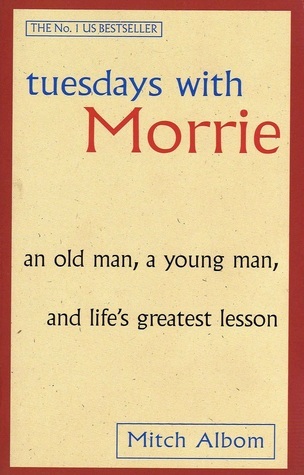
- Tuesdays with Morrie…an old man, a young man, and life’s greatest lesson by Mitch Albom. Often considered the greatest memoir of all time, Tuesdays with Morrie by Mitch Albom (born May 23, 1958) tells the story of how Albom reconnected many years later with Morrie Schwartz, his former sociology professor who was then dying from amyotrophic lateral sclerosis (ALS). The book tells the story of 14 Tuesdays when Albom traveled from Michigan to Massachusetts to visit with Morrie and hear his old professor talk about various life experiences. It was not just time well spent; it was priceless. As Albom wrote in the book, “But my old professor had made a profound decision, one he began to construct the day he came out of the doctor’s office with a sword hanging over his head. Do I wither up and disappear, or do I make the best of my time left? he had asked himself. He would not wither. He would not be ashamed of dying. Instead, he would make death his final project, the center point of his days… He could be research. Study me in my slow and patient demise. Watch what happens to me. Learn with me. Morrie would walk that final bridge between life and death, and narrate the trip.” There is much to learn not just about dying, but also living, loving, teaching, dignity, and sharing throughout Tuesdays with Morrie, and Albom’s admiration, respect, and love for Morrie Schwartz shines through.

- Fahrenheit 451 by Ray Bradbury. As is shared on the back cover of the 60th Anniversary Edition of Fahrenheit 451 by Ray Bradbury (August 22, 1920 – June 5, 2012), “Sixty years after it original publication, Ray Bradbury’s internationally acclaimed novel stands as a classic of world literature set in a bleak, dystopian futuristic American city. Today it’s message has grown more relevant than ever before.” The book tells the story of a society that outlaws books and forces its people to watch mindless television programs instead. The main character is fireman Guy Montag, whose job is to destroy all books that are found as well as the houses where they were hidden. At first, Montag simply does his job and does not think of any consequences. Then he meets Clarisse, a young neighbor who describes to him a past society where the people did not live in fear and tells him of the present danger of not being able to see the world through the written word in books nor think independently. With her influence, Montag questions all he has ever known and opposes the government. His wife, Mildred, turns Montag into the authorities for having a stolen book and the authorities force Montag himself to set his house on fire. There is no end to what the authorities will do to restore their power and they completely destroy the city. Read the book for the exciting action and ongoing tension as Montag and his new friends work endlessly to rebuild civilization.
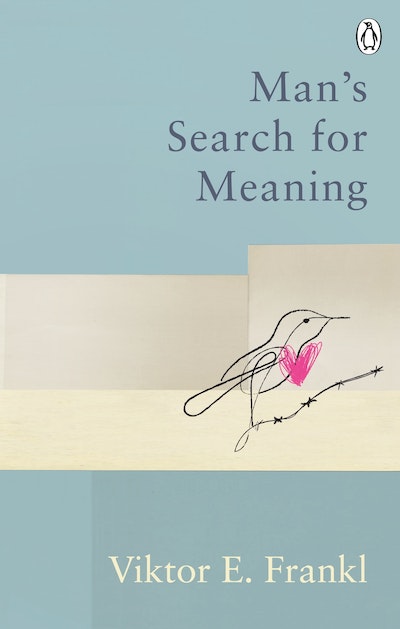
- Man’s Search for Meaning by Viktor E. Frankl. Between 1942 and 1945, Austrian neurologist and psychologist Viktor Frankl (March 26, 1905 – September 2,1997) labored in four Nazi death camps, including Auschwitz where his wife, their unborn child, his parents, and brother all perished. In Man’s Search for Meaning, Frankl disagrees with Sigmund Freud’s theory that humans’ primary drive is to derive pleasure. Instead, based on his own life experiences and those of numerous patients, Frankl argues it is to discover and pursue what we find to be meaningful. There will be suffering in this life, Frankl admits, but we have the ability and power to choose how to cope with it. The key is to find meaning in the suffering and move forward with a renewed purpose and resolve. Harrowing, meaningful, and inspiring, Man’s Search for Meaning is a must read to learn the great extent humans can go to be evil and to fight against it – and so history will not repeat itself in such a horrific way again.
I love books and read so much that doing a list of only ten books is challenging to me. I could easily list my 50 top books, but for now ten will have to do. The purpose of the list is to share books I enjoyed and to have fun. Perhaps I will expand my favorites list in the future. I keep a book journal where I list every book I read. That way, I can go back and easily pick out my favorites. You may also benefit from keeping track of the books you read. Happy reading!
###
From Here to the Great Unknown…A Memoir by Lisa Marie Presley & Riley Keough
Initially, I did not have much interest in reading From Here to the Great Unknown. My sister, CJ, has always been the big Elvis fan. But when I kept seeing the book turn up time and time again, I figured someone, somewhere was insisting I read it. Still not expecting too much from it, I did.
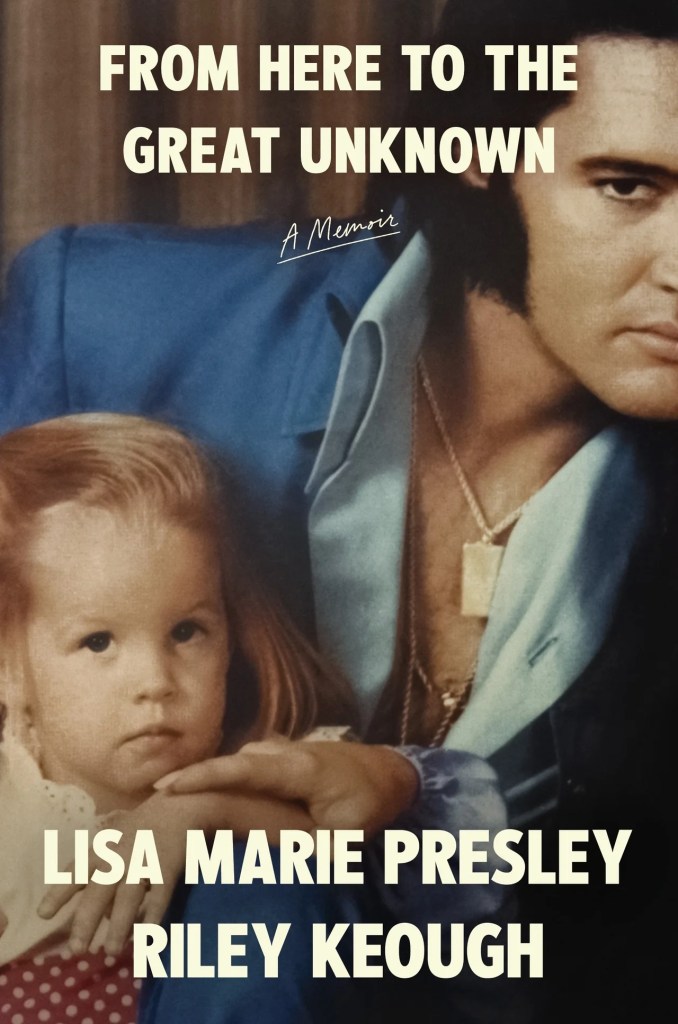
The book was originally intended as Lisa Marie Presley’s story to tell, but as her health and strength deteriorated, she asked her daughter, Riley Keough, to help her complete the manuscript. As a result, we get both mother and daughter’s points of view, and that is definitely an interesting aspect of the book.
Most everyone knows or thinks they know about Elvis and Priscilla Presley’s daughter, Lisa Marie. While her parents shielded her from as much publicity and intrusion as they could, the paparazzi never let up and it was next to impossible for Lisa Marie to have any kind of normal childhood. Elvis was often away on tour or performing in Las Vegas, and after Elvis and Priscilla split-up, Lisa Marie was shuttled back and forth between Graceland and Los Angeles.
She had, of course, just about anything she wanted while growing up. Elvis even named his jet after her, so the first thing people would see when Elvis arrived anywhere was the name Lisa Marie painted on the aircraft. It is gratifying, though, when Lisa Marie shared her favorite times from her childhood were simply being at home with her dad. It was fun when Elvis reserved an entire amusement park or movie theater so she could have fun, but the security and warmth she felt at Graceland was even better.
Lisa Marie was nine years old and at Graceland when Elvis passed away, and seeing the flurry of police, rescue, and coroner activity was harrowing to her. She was happiest when she was with her father, and now he was gone and her life would never be the same. She had her wild days while in school and experimented a bit with drugs. For the most part, though, she understood how drugs – whether prescribed by a physician or not – killed Elvis, and she lived most of her life without them.
She and singer Danny Keough married and had two children, Riley and Ben, and things were good until Lisa Marie became infatuated with Michael Jackson. With Michael, she finally had someone who understood the pressures associated with being famous. She left Danny and married Michael, but that marriage only lasted a couple of years. The sticking point was Michael’s desire to have children and Lisa Marie’s reticence to add more children to her family at that time.
Incredibly, Danny remained a steady presence and influence, not just with Riley and Ben, but also supporting Lisa Marie. This became even more important years later when Lisa Marie, by then with Michael Lockwood, delivered twins Harper and Finley via c-section. Doctors prescribed opioid pain medication following that surgery and Lisa Marie soon became addicted.
Her addiction grew over the next several years and she failed at several half-hearted attempts at recovery. Her health worsened until she suffered a seizure that scared her enough to take her recovery seriously. Her son Ben’s suicide in July 2020, though, was the straw that broke what was left of Lisa Marie’s spirit. Riley shares the unusual story of Lisa Marie keeping Ben’s body at home for months before finally burying him at Graceland near Elvis’ grave.
After that, Riley said her mother no longer cared about her health or her life. Lisa Marie tried to do as much as she could for her twins, and found some greater purpose by teaming with Riley to provide suicide prevention programs.
Lisa Marie passed away in January 2023 and was also laid to rest at Graceland. Riley’s eulogy for her mom is included at the end of the book, with the following expression of gratitude and love. “Thank you for showing me that love is the only thing that matters in this life. I hope I can love my daughter the way you loved me, and the way you loved my brothers and sisters.”
So, Lisa Marie, who felt unworthy and troubled since losing her father when she was a child, was remembered for making a positive difference for her loved ones and others.From Here to the Great Unknown provides several lessons about addiction, grief, self-esteem, privilege, frustration, and love; and is well worth the read.
###
Robert B. Parker’s Hot Property…A Spenser Novel by Mike Lupica
I began reading Robert B. Parker books a long time ago and have always appreciated their great characters, excellent dialogue, fast pace, and the inclusion of family, friendship, psychology, honor, poetry, sports, and love. Parker was so good at mixing personal relationships into his books while their main plots moved forward, leaving clues along the way for readers to solve each mystery.
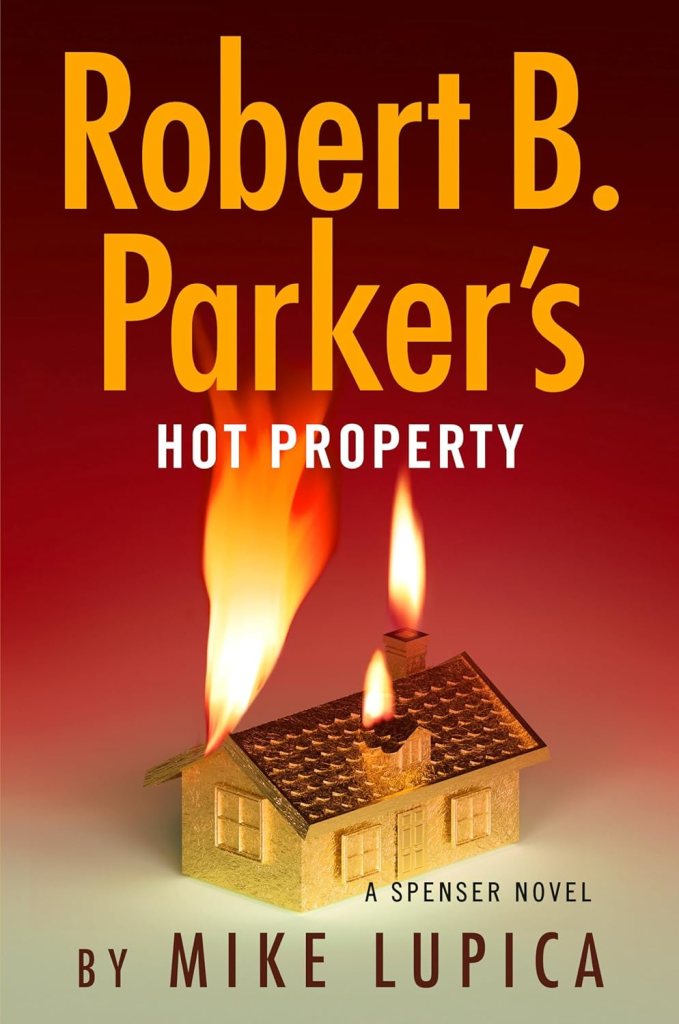
When Parker passed away in 2010, I feared I’d read the last adventures of private investigator Spenser, Hawk, Dr. Susan Silverman, Jesse Stone, Rita Fiore, and Sunny Randall. It is difficult to follow in the footsteps of a great writer, but fortunately the Parker family found Mike Lupica, a close friend of Robert B. Parker, and an award-winning sports columnist and novelist in his own right, to, at first, continue writing the Sunny Randall and Jesse Stone series. He has done so wonderfully in continuing Parker’s voice and also adding his own, that he is now also writing Spenser novels.
Lupica’s first Spenser novel was Broken Trust, published in 2023, and he followed that up late last year with Hot Property, where Spenser’s friend Rita Fiore, a high-powered, redheaded Boston attorney, has been shot. While she is in the hospital recovering from her serious wounds, Spenser and his best friend, Hawk, go about finding the shooter.
As you would expect in a Spenser novel, although it seems like he is not making any progress, the action moves along quickly as the many layers of the case are investigated. It is no surprise that Spenser, despite the twists, turns, and sub-plots, always solves the case. Without giving up too much of the story, Rita’s wounds, her recovery, and other characters’ various brushes with death, lead to an exciting conclusion.
It is a special treat in Hot Property that Lupica brings Jesse Stone, chief of police in a small town near Boston and another longtime Parker character, into the Spenser story. Stone is a recovering alcoholic and former professional baseball prospect who previously worked in a large police department in California. Given the ups and downs of his addiction and lost loves along the way, he prefers being in a smaller setting. He, too, is close with Rita, so her being shot is a personal affront to both of them. Stone helps Spenser from time to time throughout the book until the case is solved.
And, of course, no Spenser book is complete without Susan, Hawk, and Lt. Martin Quick and Frank Belson of the Boston Police Department. Lupica even includes Vinny Morris in this one, as well as references to other characters from Spenser’s past.
It all adds up to a great read, one that flows easily, keeps readers thinking, and is enjoyable. Lupica honors the family, style, and memory of the great Robert B. Parker. He totally gets Parker’s expertise and intent in writing witty dialogue, and the characters’ banter – even when Spenser is asking difficult questions – rings true to the long series of Spenser titles.
When Peanuts creator Charles M. Schulz passed away in February of 2000, his family announced it was the end of his famous comic strip. They did not want anyone else to continue drawing Charlie Brown, Snoopy, and the gang. I understand where they were coming from, since Charles Schulz spent fifty years sharing Peanuts with us.
At the same time, thank you to the family and estate of Robert B. Parker that a talented writer like Mike Lupica is not only keeping Parker’s characters alive, he is also blessing long-time Parker readers with exciting new gifts to read and enjoy. Parker’s first Spenser novel, The Godwulf Manuscript, was published in 1973, so if you are new to this character there is a large volume of previous titles for your reading pleasure. Either way, you will enjoy reading Lupica’s latest Spenser story.
Hot Property is the 51st Spenser book in the series, and I look forward to reading what comes next.
###
Patriot (A Memoir) by Alexei Navalny
Russian lawyer, politician, and opposition leader Alexei Navalny spent the majority of his life committed to making things better for his fellow citizens. It was a continuous, steep, uphill battle, with Navalny fighting hard for democracy and improved living conditions in his native country. He made some inroads thanks to his creative spirit, ability to motivate other people, usage of social media, and overall strength to stand tall in the face of oppression. Navalny passed away in custody at age 47 early in 2024, so what happens next in his opposition movement is up to those he left behind.
An outspoken critic of Russian president Vladimir Putin, the Kremlin, and the power exhibited by the government to suppress anyone with the nerve to get in their way, Navalny’s incessant efforts, not surprisingly, caught Moscow’s attention. His memoir, Patriot, is a firsthand account of fixed elections, false imprisonment, and abuses of governmental power – including Navalny surviving being poisoned and later being held far away in a Siberian prison.
His book explains how the Russian authorities, from Moscow and the Kremlin to the military, judicial system, politicians, police, and prison system, turn up the heat on dissidents until one way or another they no longer dissent. In Navalny’s case, he was immediately arrested upon his return to Russia after recovering in Germany from being poisoned – as he knew would happen – but he returned anyway to further the opposition’s cause even if it meant imprisonment and death.
When opposition candidates performed well in elections, Navalny claimed those in power resorted to ballot rigging to ensure victory for the state. The Russian state controls everything – the economy, the schools, the media, supplies of goods and services, the military, and the courts – and does so with authority and dispatch.
The threat of risking life and limb to fight the system is usually an effective deterrent to future opposition. Better to stay quiet and alive than to be dealt with for speaking out.
The threat and eventual reality of imprisonment, bodily harm, and death, though, did not prevent Navalny from opposing a president and ruling group intent on silencing him. He gained a large following over the years, and when he was arrested and sent to prison on a series of false charges, his colleagues did what they could to continue spreading his message. That task became even more challenging without their leader and the memory of his death fresh in everyone’s mind.
During one of his many fraudulent court proceedings, Navalny found the judge to be so blatantly corrupt and “in Putin’s pocket,” that Navalny finally came to terms with the fact the system would never allow him to again be released. Even that did not stop his dedication to the cause.
He went on a hunger strike and experienced the fallacy of proper nutrition and medical care in the Russian prison system. It was as if they did not care if the prisoners lived or died, especially those with the audacity to oppose the Russian government. All too often, such prisoners – Navalny included – left prison in a body bag.
Accepting his fate, it became even more important to Navalny that his memoir and prison diary be published. He saw Patriot, which he wrote the majority of while recuperating in Germany, as his lasting message of hope and inspiration so others can continue to fight for freedom. He wanted readers to contrast the stories of people getting up early in the morning to stand in line for hours to buy bread and milk with the opulent lives lived by Putin and his inner circle.
The weeks following the 2024 presidential election in the United States was the perfect time for me to read Patriot. Finishing Navalny’s memoir will make you shake your head in disbelief at those Americans who were so distraught by the election’s outcome they couldn’t get out of bed and resorted to tears, gnashing of teeth, and pledges to leave the country. Can you imagine them living in the Russia Navalny described?
This vast contrast between Putin’s Russia and the west is so strikingly evident, it is obvious those saddened by America’s recent election would never make it under the Kremlin’s control. That is, of course, unless they were able to join the Russian elite.
Navalny’s book is a bit long, notably in its later prison diary entries, but is still recommended reading. There is nothing more effective than a personal, firsthand account of how far the Russian state will go to silence opposition to show what true suppression looks like.
And that is what is known as having perspective.
###
Invention in PR by Adam Ritchie
By David A. Jolley, APR*
*Accredited in Public Relations by the Public Relations Society of America (PRSA)
I have been part of the public relations (PR) industry for the past 45 years and have heard so many talks and presentations I’ve lost count. When I had the pleasure, though, of attending a Public Relations Society of America (PRSA) program featuring Adam Ritchie talking about his latest book, Invention in PR, I took notice.
Adam, you see, is instrumental in the effort to elevate the public relations profession from not only serving as the voice of an organization, but also as its creative engine. Adam advocates for PR to be involved with inventing products and services rather than just promoting them. Adam makes a compelling case in his book, Invention in PR, for public relations to seize the opportunity by proactively identifying and developing product or service ideas first.
With its solid background and expertise in media and community relations, and serving as the company’s eyes and ears in the public, PR is well suited to create newsworthy offerings that meet consumer needs. And it is tremendous, indeed, when everyone comes together and stretches the definition of what is possible.
Adam’s book takes you step-by-step through the creative process, from product and service development to promotional campaigns and success measurement. He includes numerous examples of invention in PR at work; effective campaigns backed by strong products/services that meet a need and exceed consumer expectations. It’s all about useful and effective invention from beginning to end. Remember, everything must protect and strengthen the brand.
With my longstanding involvement with issues, crises, and reputation management, I was especially interested in Adam’s chapter on Invention in a Crisis, and he did not disappoint. The chapter is filled with examples of creative approaches to crisis communications. Of course, discretion is necessary depending on the nature of the businesses and crises themselves.
During the height of the pandemic when people were adamant about staying six feet away from one another, Dos Equis saved the day by making a six-foot beer cooler. Burger King provided “Safe Order Masks” printed with order forms patrons could use at the restaurant’s drive-through lanes. Taking advantage of the increase in people staying at home and playing games, Heinz offered an all-red, 570-piece “Ketchup Puzzle.” Later, when the restrictions eased, it was another beer brand, Heineken, that helped people come out of hiding by providing mobile hair salons parked outside bars and pubs so patrons could get haircuts while sipping on a cold Heineken.
Invention in PR explains the many possibilities there are to expand the PR profession, and should be read by everyone in PR, of course, but also those in additional fields, including executive leaders, business owners, employers, operations leaders, and anyone interested in how to be inventive and creative.
“Start with a concept. Work with a manufacturer, a cause or a relevant influencer group to make it real. Then do what PR excelled at for its first 100 years – tell the story,” advises Adam. “Do that, and you’ve made the leap from communicating about things to inventing them.”
One other thing. Be sure to read and absorb Invention in PR.
###
1967…How I Got There and Why I Never Left (A Memoir) by Robyn Hitchcock

Although the vast majority of 1967…How I Got There and Why I Never Left by Robyn Hitchcock takes place during the title year, the book provides an inside look at the music and culture that exemplified most of the 60s. At the center is the author’s story of being sent to an academic boarding school in England where he mostly studied the music of Bob Dylan, along with the Beatles, the Rolling Stones, Procol Harum, and more. He and his record player were constant companions and he dabbled with drawing and art.
He shares his experience at the Winchester School by writing about strange and eccentric faculty members and fellow students, with a ‘music of the times’ theme throughout. There are the typical pranks as well as disgusting habits of classmates/roommates, and you sense a little bit of The Catcher in the Rye and a Holden Caulfield feeling from time to time.
The year 1967 is significant because it was Hitchcock’s second year at the school, the year he was no longer the little kid pining for home, but a maturing 13-year-old faced with determining what he wanted to do with his life. So, naturally, he set his sights on playing the guitar, getting high, traveling to Nashville, Tennessee, and becoming a musician.
Much like a year does, the book ends abruptly with only a short epilogue to tie everything together. Hitchcock’s memoir could have been better served with more details about how his infatuation with 1967 helped him prosper throughout a multi-decade career. Without this material he doesn’t explain well why he remained stuck in 1967 for life, other than the book’s last line, “I’m grateful that the stopped clock of 1967 ticks on in me – it’s given me a job for life.”
He admitted, after all, that Bob Dylan changed with the following year’s album release, John Wesley Harding. “The exhilaration was gone, he (Dylan) was older and wiser,” Hitchcock wrote. Listening to the album, Hitchcock knew he would return to the previous year’s Highway 61 and Blonde on Blonde.
Hitchcock succeeded in having a career in music. Described as a “rock ‘n roll surrealist,” he played in various bands and enjoyed a long career as a songwriter. His bio on the dust jacket of 1967 tells us, “Hitchcock has floated as a tangent to the mainstream for nearly five decades, and his songs have been performed by R.E.M., the Replacements, Neko Case, Gillian Welch & David Rawlings, Lou Barlow, Grant-Lee Phillips, Sparklehorse, and Suzanne Vega with the Grateful Dead.”
In his acknowledgments, Hitchcock tells us he wrote and edited the book entirely on his phone which may explain some of its shortcomings. The book was interesting and worth the read, but I feel it could have achieved more with such an intriguing concept.
###
George Harrison on George Harrison; Edited by Ashley Kahn
I have always been a huge George Harrison fan, from his supposed quiet days with the Beatles (he was not really quiet), through his post-Beatle solo career, and then with the Traveling Wilburys. His music speaks for itself, and now, in George Harrison on George Harrison, he speaks for himself as well.
The book is a compilation of many of his letters, interviews, and encounters with the media and public over the years and it provides a look into George Harrison not just as a musician, but also as a man, husband and father, colleague, reluctant businessman, and spiritual seeker. I was just ten years old at the time, so I didn’t understand his spiritual messages in 1967 when he and his bandmates traveled to India. It was there that George first learned about the power of meditation and began his lifelong walk down a spiritual path. But as George spoke more and more about enlightenment, my interest grew and I better understood his beliefs about life.
Little by little, Harrison spoke his feelings and shared his opinions during interviews that in the beginning were dominated by John Lennon and Paul McCartney. (They even let Ringo get a word or two in from time to time.) Most of the Beatles songs were written by Lennon and McCartney, but then one or possibly two songs per album were written by Harrison. Although he became a prolific songwriter, it remained difficult for him to get many of his songs recorded and included on Beatles records. As a result, he had a stockpile of songs ready when the Beatles broke up, so he was more than ready to move forward with his solo career.
In addition to the interviews themselves, the book includes short introductions to each piece that inform readers of the interviewer, media outlet, and context of each interview. I found it interesting to read how George opened up and became more comfortable talking about topics other than music. He spoke of meditation, spirituality, consciousness, and enlightenment, as well as his endeavors in being a filmmaker and some detail about his personal life. He was not bashful to point out the wrongs he saw around the globe and he let politicians know his opinions from time to time.
Above all, George spoke of the soul and his belief in reincarnation – that humans keep coming back to earth lifetime after lifetime until we learn all the lessons we need to learn. When that is accomplished, our souls move on to a higher realm. He easily moves from talking about details of specific songs and recording sessions to his more ethereal interests and thoughts about religion. (We’re all one, he told us.)
His early appearances with Dick Cavett and David Frost, his interviews with Rolling Stone, BBC, and others, and his final online Q&A sessions are all included in George Harrison on George Harrison. The book also includes a statement from George and his wife, Olivia, in January 2000, soon after a home invader stabbed George multiple times. The statement expressed their deep appreciation for all of the well wishes and messages of support.
The book ends with George’s last words that he asked to be shared around the world after his passing on November 29, 2001. The message he left us with is, “Everything else can wait, but the search for God cannot wait, and love one another.” The man who sang All Things Must Pass lived and died in the knowledge that his spirit – his soul – will never die. Thankfully, we have his music catalog and this extensive compilation of his interviews and messages to remind us about him always.
###
The Fireballer by Mark Stevens
I knew I’d found a kindred spirit in author Mark Stevens when I found out that he does not like the designated hitter. Neither do I. Not only does it take away much of the game’s strategy, but a pitcher who doesn’t have to bat also doesn’t have to worry about personal retribution when he hits a batter with a pitched ball.

Stevens’ latest novel, The Fireballer, magnifies the strategy of a season, a game, and even a single at-bat, as well as the lengths teams and their owners will go to win or prevent someone else from winning. He does this with his main character, Frank Ryder, the fireballer himself, who is a combination of Randy Johnson, Aroldis Chapman and a howitzer, with a large helping of Jack Armstrong, the All-American boy.
Ryder has extraordinary pitching ability, and he throws the ball faster than anyone has ever done before. He’s not just a generational talent, he’s a talent of the century – at least until the next flame-throwing prospect comes along. When he is on the mound, the other teams have zero chance of winning.
Ryder is the ace of the Baltimore Orioles and returns the team to the top of the standings. It’s a happy coincidence that the real Orioles are in first place in the American League East at the time of this writing. That hasn’t happened this late in the season in a long time. Maybe Stevens knows something.
Baseball Hall-of-Famer Yogi Berra once said something to the effect that, “Ninety percent of this game is half-mental,” and Stevens does a good job of including the mental aspects of baseball in his book. He also sprinkles various baseball references and tidbits throughout, something I definitely enjoyed.
As an added touch, the actual hardcover of the book is designed as a baseball with the stitches clearly visible. But it’s what’s on the pages inside that really matters.
Like most main characters, Frank Ryder has a flaw, something he must continuously face and overcome as he balances life in the major leagues, winning, and personal happiness. You’ll have to read The Fireballer to find out what happens, and Stevens provides an interesting twist as Ryder contemplates who he really is inside and what is most important to him.
For fans of baseball and good fiction alike, The Fireballer delivers interesting and enjoyable characters, dialogue, and a fast-moving plot.
You don’t have to be a baseball fan to enjoy this book, but lovers of the game will get even more from its many references to our national pastime.
So, sit back and enjoy the read. And while you’re at it, keep an eye on this year’s Baltimore Orioles. Frank Ryder may be a fictional character, but the Orioles are finally once again for real.
Like a great baseball game, a hot dog, and a tall, ice-cold beer, The Fireballer is satisfying, enjoyable, and fulfilling.
###
The Archer by Paulo Coelho
Paulo Coelho is most famous for writing The Alchemist, to this day regularly assigned as required reading in high school and college literature classes, and considered among the most influential books of all time. In his book, The Archer, though Coelho again reaches for and grasps the stars with his insightful writing.
The Archer tells the story of Tetsuya, a world-class marksman with the bow and arrow, who lives a quiet life as a carpenter. He believes his days as an archer are behind him and is content with his comfortable existence. One day, though, a stranger arrives in town, looking for the champion archer he wishes to challenge. He confronts Tetsuya, who carefully unwraps his bow, feeling he has no choice but to answer this call.
The challenger is formidable, but Tetsuya teaches him a valuable lesson about the difference between performing when the setting is perfect and when it is difficult. The story centers on Tetsuya’s answers to the questions of a young boy who witnessed the stranger’s challenge and the champion’s response.
The book is a quick read, but you will want to go back and read it again and again; each time absorbing more of its life wisdom. There are multiple levels to this fine book, lessons about physical competition as well as deeper lessons about patience, concentration, risk-taking, making adjustments, joy, tranquility, refraining from judgment, the power of intention, dedication, and courage.
Tetsuya teaches the young boy all he needs to know to live a successful life. All the boy has to do is, as Coelho puts it, “have patience, work hard, respect the seasons, and not to curse the storms, because it would be a waste of time.” The lessons are all presented as qualities required to be an expert archer, but they have a universal application.’’
From intention comes action and ultimately meaning. Two of the many passages from the book that particularly speak to me are “a leaf does not cease to be a leaf merely because a storm tore it from the tree,” (page 64) and “water never forgets that the sea is its destiny and that sooner or later it must be reached” (page 25).
So, don’t just read The Archer quickly and forget about it. Instead, embrace it and learn its lessons. They apply to everyone, and those who study this roadmap toward a meaningful life will be so much further on the path to achieving it.
###
David Jolley is a sports fan and historian, public relations/marketing communications consultant, writer, and the author of A Good Cup of Coffee…Short-Time Major Leaguers and Their Claims to Fame. He writes a sport column that appears periodically in the Wilkes-Barre, PA, Times Leader newspaper.
Reach him at djolley1231@yahoo.com
###
- Myers, Paul, John Candy – A Life in Comedy, ©2025, House of Anansi Press, Inc., Toronto, CA, p. 312. ↩︎
- Myers, Paul, John Candy – A Life in Comedy, ©2025, House of Anansi Press, Inc., Toronto, CA, p. 319. ↩︎
- Barry, Dave, Class Clown…The Memoirs of a Professional Wiseass – How I Went 77 Years Without Growing Up, ©2025, Simon & Schuster, NY, NY, p. 225. ↩︎
- Barry, Dave, Class Clown, p.26. ↩︎
- www.mitchalbom.com ↩︎
- McChrystal, General Stanley, On Character…Choices That Define A Life, ©2025 McChrystal Group, LLC, Portfolio/Penguin Publishing, NY, NY, p.49.
↩︎ - McChrystal, General Stanley, On Character…Choices That Define A Life, p.96.
↩︎ - McChrystal, General Stanley, p.105. ↩︎
- McChrystal, General Stanley, p.106. ↩︎
- McChrystal, General Stanley, p.132.
↩︎ - McChrystal, General Stanley, p.132. ↩︎
- McChrystal, General Stanley, p.260. ↩︎
- McChrystal, General Stanley, p.201. ↩︎
- Patterson, James and Ward, Vicky; The Idaho Four…An American Tragedy, ©2025, Little Brown and Company, New York, p. vii. ↩︎
- Patterson and Ward, The Idaho Four…An American Tragedy, p. 254, 255. ↩︎
 David A. Jolley - Homepage